Thursday, February 5, 2009
Wednesday, February 4, 2009
Admitting that you have a problem
 The first step is to admit that you have a problem.
We got a call from Pepperidge Farms the other day. They wanted to offer us payroll deduction, in order to simplify our monthly Goldfish bill and consolidate our baked snack expenditures.
It started out innocently, as I’m sure all addictions do. It was time for Z’s dinner, but I didn’t have anything ready yet. But he was hungry, so I put him in the chair and tossed him a couple of Goldfish to keep him happy. I didn’t even know where they had come from... M. had picked them up at one of her twice-a-day stops at Target. So I toss him a couple or three... and I casually pop one into my mouth. Then I open the fridge, dig around for some soup or pasta or something for Z. ... and I unconsciously reach again for the Goldfish. I’m mashing Z’s dinner with the avocado masher... and I take another handful. Z’s a big agitated because I’m taking so long, so I toss him a couple more... and it’s one for him, two for me, another for him, another handful for me. The next thing I know, in between giving Z. spoonfuls of his dinner, I’m tipping up a now-empty bag of baked Cheddar heaven to my mouth and inhaling the last few crumbs.
And like all addicts, I tell myself, no one else saw me, it was just this once, and I’ll never do it again.
And then M. comes home with a bag of the Goldfish with the little fishy pretzels mixed in.
Same story: casual snacking while feeding Zebb turns into me cannonballing a whole bag of crackers.
Now it’s my turn to get groceries, and I’m walking down an aisle that before now I didn’t even know existed. I vaguely remember the concept of the Pepperidge Farm Goldfish snack cracker, but I hadn’t bought a bag in twenty years. Turns out they come in every flavor under the sun: cheddar, parmesan, pretzel, whole grain, toasted corn, and mixed bags. They come in the traditional size and itty bitty baby-sized crackers, and starfish as well. And don’t even get me started on graham and chocolate.
At first it was my shameful little secret, chowing down on Goldfish when no one but Z was looking. But like all junkies, at some point I stopped caring who saw me. I’m making Z’s dinner, and I have a ramikan of Goldfish next to me. I’m making our dinner, and I’m taking them by the handful right out of the bag. I’m at school, and I have a ziplock bag of them on my desk. I’m driving to get Z from daycare and I have a little cup of them in the holder that before now has only ever seen coffee.
I’ve convinced myself that I’m not a Goldfish junkie but a Goldfish connoisseur. I mix cheddar and pretzel Goldfish with pistachios and tell myself I just invented something. Instead of saltines or oyster crackers, Goldfish are in my chicken soup. Crushed Goldfish replace breadcrumbs as a dusting for baked zucchini. The options are endless...
And like most junkies, I’m taking down the people around me. When I hand M. her packed lunch, she asks, “Did I get some Goldfish?” The dogs hover around Z’s highchair waiting for him to drop one, and then they pounce like sharks in chummed water. Even the finicky cats are in on it. I watched Fatty find one of Z’s discards, polish it off with a couple of bites, and then sit there and lick the cheddar powder off of the floor.
Step one is admitting that you have a problem. If anyone knows of a good support group, please let me know.
Next week: Rediscovering graham crackers
Winter Running Tips
Winter running tips from ChiRunning.
Check it out here.
You know you're listening to a die-hard runner when he's talking about taking an exacto-knife to his shoes' insoles.
Also worth reading at Well: Are your kids getting enough exercise?
School Recess Improves Behavior
Also worth reading at Well: Are your kids getting enough exercise?
School Recess Improves Behavior
Happy trails!
Tuesday, February 3, 2009
The Greasy Skillet asks...
High Plains Update
 Don't call it "global warming." Around here, it's called "global spinning around in circles, so don't even try to guess what's up tomorrow."
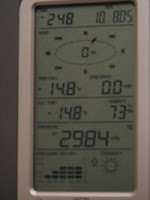 This time of the year, if you stick your head out the front door at high noon, you have a one in four chance of guessing what season it is. A week ago it was sunny and in the 60s. A couple of days later, below zero and snowing. And now it's back in the 50s. There's green in the fields where everything should be golden, except for where's there's snow. (That says minus fourteen, there on the left.)
Even the geese are confused. They're flying north, south, east, west, all over the place. No idea which way they want to go.
Our neighbors to the east over at The Greasy Skillet are asking what it is that you love about your town.
If I had to build a perfect town from scratch, I can think of a couple of places to start. You'd have a beach a mile away, bike friendly roads, and a little Italian place two blocks from the house like we had in Kailua. You'd have cool clubs and coffee shops like the Exit In and Bongo Java (of Nun in the Bun fame), from Nashvegas. You'd have vineyards right outside your front door and the Alps around the corner, like in Lehrensteinsfeld.
I don't have any of those things here in High Plains country, but I'm not complaining, not at all. It would be nice to have a bit more culture within walking distance, but the big city’s a quick hop down the road. After living in Baltimore, Wash DC, Atlanta, and other east coast big cities, this is as big as I ever want to go again.
The thing I don’t quite understand myself is, this place just feels like home to me. I grew up all over the east coast, but I didn’t realize until I left how claustrophobic I felt there. Especially in Georgia, living under 70 foot pines that didn’t let the day light in until maybe ten a.m. Out here, when Mr. Sun comes up, there’s no doubt about it — he’s looking in your window, telling you it’s time to get up and get to work.
 Don’t get me wrong... it’s hard to beat Asheville, NC in the fall for sheer natural beauty, or the hills of western Pennsylvania, upstate New York, or the North Georgia mountains. But to me, those are great places to visit. Living there is a different story.
Back before the Iraq and Afghanistan wars started, about the toughest thing one could do in the Army was go through the National Training Center at Ft Irwin, California. The National Training Center is basically in Death Valley, about as rugged a place to train as you’ll ever encounter. And to this day, I’m the only person I’ve ever met (awkward construction, but you know what I mean) who came back from there talking about how gorgeous it was. Yeah, it was a desert, nothing but rock... but if you looked hard enough, you could find flowering plants fighting their up through the rock. In the middle of nowhere, life was finding a way.
 And that’s how I feel just about every day here. To some, picturesque might mean forested hillsides or fields of bluegrass or the rich colors of wildflowers. But I personally prefer the hardiness and ruggedness of something that’s just doing it’s best to survive. Desert plants that get by with a drop of water now and then, that are just barely green enough to capture light and CO2 and turn it into oxygen and new branches. Yeah, a magnolia tree on a southern plantation has it’s place, but can it roll down the highway at 60 mph like a tumbleweed? One bad ice storm and those 70 foot Georgia pines will be laying in your driveway (or in your kitchen, as we learned the hard way), but the plants here just shrug it off and silently remind you to quit whining. These plants are survivors.
 And the same with the wildlife. Hawks and eagles circle overhead, reminding the little furry critters that they’d better not dilly dally unless they want to be supper. Foxes and coyotes roam the fields, reminding us that dogs were meant to have jobs, to work and play hard, and not to run around an arena, prancing for a judge. Even the cute little bunnies that run around in our yard aren’t hippity-hopping off to find Easter baskets but are part of this fight for existence, digging holes to hide from said eagles and coyotes and trying to survive temps that go from 100º to below zero practically over night.
I have no idea how the product of Pennsylvania and Florida genetic material, with roots in a Mulligan stew of European rolling hillsides, came to feel at home out here. Either reincarnation or alien abduction must be part of the answer. But whatever the reason is, this place just feels right to me.

 Don't call it "global warming." Around here, it's called "global spinning around in circles, so don't even try to guess what's up tomorrow."
 This time of the year, if you stick your head out the front door at high noon, you have a one in four chance of guessing what season it is. A week ago it was sunny and in the 60s. A couple of days later, below zero and snowing. And now it's back in the 50s. There's green in the fields where everything should be golden, except for where's there's snow. (That says minus fourteen, there on the left.)
Even the geese are confused. They're flying north, south, east, west, all over the place. No idea which way they want to go.
Our neighbors to the east over at The Greasy Skillet are asking what it is that you love about your town.
If I had to build a perfect town from scratch, I can think of a couple of places to start. You'd have a beach a mile away, bike friendly roads, and a little Italian place two blocks from the house like we had in Kailua. You'd have cool clubs and coffee shops like the Exit In and Bongo Java (of Nun in the Bun fame), from Nashvegas. You'd have vineyards right outside your front door and the Alps around the corner, like in Lehrensteinsfeld.
I don't have any of those things here in High Plains country, but I'm not complaining, not at all. It would be nice to have a bit more culture within walking distance, but the big city’s a quick hop down the road. After living in Baltimore, Wash DC, Atlanta, and other east coast big cities, this is as big as I ever want to go again.
The thing I don’t quite understand myself is, this place just feels like home to me. I grew up all over the east coast, but I didn’t realize until I left how claustrophobic I felt there. Especially in Georgia, living under 70 foot pines that didn’t let the day light in until maybe ten a.m. Out here, when Mr. Sun comes up, there’s no doubt about it — he’s looking in your window, telling you it’s time to get up and get to work.
 Don’t get me wrong... it’s hard to beat Asheville, NC in the fall for sheer natural beauty, or the hills of western Pennsylvania, upstate New York, or the North Georgia mountains. But to me, those are great places to visit. Living there is a different story.
Back before the Iraq and Afghanistan wars started, about the toughest thing one could do in the Army was go through the National Training Center at Ft Irwin, California. The National Training Center is basically in Death Valley, about as rugged a place to train as you’ll ever encounter. And to this day, I’m the only person I’ve ever met (awkward construction, but you know what I mean) who came back from there talking about how gorgeous it was. Yeah, it was a desert, nothing but rock... but if you looked hard enough, you could find flowering plants fighting their up through the rock. In the middle of nowhere, life was finding a way.
 And that’s how I feel just about every day here. To some, picturesque might mean forested hillsides or fields of bluegrass or the rich colors of wildflowers. But I personally prefer the hardiness and ruggedness of something that’s just doing it’s best to survive. Desert plants that get by with a drop of water now and then, that are just barely green enough to capture light and CO2 and turn it into oxygen and new branches. Yeah, a magnolia tree on a southern plantation has it’s place, but can it roll down the highway at 60 mph like a tumbleweed? One bad ice storm and those 70 foot Georgia pines will be laying in your driveway (or in your kitchen, as we learned the hard way), but the plants here just shrug it off and silently remind you to quit whining. These plants are survivors.
 And the same with the wildlife. Hawks and eagles circle overhead, reminding the little furry critters that they’d better not dilly dally unless they want to be supper. Foxes and coyotes roam the fields, reminding us that dogs were meant to have jobs, to work and play hard, and not to run around an arena, prancing for a judge. Even the cute little bunnies that run around in our yard aren’t hippity-hopping off to find Easter baskets but are part of this fight for existence, digging holes to hide from said eagles and coyotes and trying to survive temps that go from 100º to below zero practically over night.
I have no idea how the product of Pennsylvania and Florida genetic material, with roots in a Mulligan stew of European rolling hillsides, came to feel at home out here. Either reincarnation or alien abduction must be part of the answer. But whatever the reason is, this place just feels right to me.

Thought for the Day
From an interview with food critic Patricia Wells.
Q - You once said, "Americans eat every meal as if it is their last."
A - "And the French know that there will be more tomorrow."
We [Americans] are still not a food culture. We don't have the respect for food. We still have a fear of food. When we sit down to eat, we have too many negatives: no fat, can't have carbohydrates. It's just no, can't, no, can't. We forget what pleasure food can give us. It doesn't have to cost much and doesn't have to be complicated. Just going to the market and buying an apple can be a wonderful experience.
Monday, February 2, 2009
I hate running.
Or at least, I have from time to time.
I've had an on again, off again relationship with running.
As a kid, I didn't think about it. I never ran track, but running was a huge part of conditioning for basketball and soccer. To get ready for the season, I never intentionally laced up my shoes and went out and pounded the pavement. Didn't need to. We ran so much just goofing off and playing that we were always in decent shape by osmosis.
Then I joined the Army, and they proceeded to suck any marginal fun that there might have been in running. It was a chore, something you had to do. And that damn airborne shuffle. Those were the shortest strides I had ever seen, and they tore up my knees. Running in formation, I was taking quarter strides to try to stay in step, so my knees were barely bending. You had to stare at the back of the head of the guy in front of you. You ran around the same loop over and over. There was just nothing cool or interesting or fun about it. So running became something I only did when I had to.
Then, during my first mid-life crisis, I'm not sure what clicked but for some reason I found myself hitting the road to try to forget my problems. And for the first time in my life, I got smart about running.
I was stationed in Korea, and my best friend at the time, a guy named Bryan Chapman (who would go on to run the Kona Ironman a couple or three times and completed the Eco-Challenge back in 2001) taught me how to run smart for the first time in my life. Up until that point, "running" meant 3-4 miles at a constant 7 minute mile pace. Duh, no wonder I hated it. What Bryan showed me was that you needed to teach your body to run fast as much as you needed to train it. You had to show your legs what fast looked like. So for the first time ever, my workouts got smart. Every run had a purpose.
A typical week would include four days of running, with no two days the same. One day was focused on speed work. There was a state park right outside the gate, so I could jog about a mile to this huge expanse of parking lots. There, I could run sprints of various distances. Maybe a hundred meters out, walk back, and repeat. I could run a handful of full-gas sprints, or I could ramp up: two at 50%, two at 75%, two at 100%, then back down. Or I could run laps around the parking lot and make up my own intervals. Whatever, that day was all about speed.
Another day was all about maintenance. Those days were 3-5 mile days, and I'd line up the return so I came back on the PT test route and could time my last two miles.
Another day was for LSD, long slow distance. I usually saved this for Saturday or Sunday, when time wasn't an issue, and it was all about ground pounding. By the time I left Korea, I was casually running 15 or 20 miles at a shot, but it took a long time to get to that point.
And the fourth day was used to keep things interesting. We had a trail running through the hills (a deer trail, really, because we never saw anyone else ever walking, hiking, or running it), and running the zig-zags of this trail was used to target the legs' stabilizing muscles. Or I'd run an ad hoc fartlek course, using my watch timer to tell me when it was time to do some push-ups or sit-ups or lunges.
So part of it was that I was for the first time learning to run smart, but the mid-life crisis part probably helped as well. I finally understood what a runner's high was all about, and I'd come back from my LSD runs thinking I had solved all of the world's problems in my head at about mile fourteen or so, and if we could just get all of the world's leaders to buy a pair of Asics and go hit the road, we could save this planet. There was a one week period when I was training up near the DMZ where I got up around four every morning and did a pre-PT run, and I saw at least a dozen shooting stars right at BMNT each day. I still remember thinking, how many of those have I missed because I wasn't running before?
This period lasted maybe ten years, and during that time, I ran a handful of marathons and whatnot. Whilst in Hawaii, I formed a team that completed the Oahu Perimeter Run, a 134 mile relay race for six-man teams. (Two of my buddies ended up getting hurt and dropping out, so I wound up running about 40 miles that day, along with my COL boss. Our team was one of the last to finish, but I couldn't have had more fun.
And then at some point I started biking instead of running. And the next thing you know, running became a chore again. It was okay, but why run when you can get twice as far twice as fast on two wheels? If the weather was crap, then that's what trainers and stationary bikes were made for. And the most boring bike ride to nowhere on a trainer can be made endurable with an iPod and a decent selection of magazines. So the circle is now complete, and I once again hate running.
But now that we have the kid and time is a premium, I'm reconsidering this arrangement. For one, I don't have the time every day to check my tires, find my duds, load my jersey pockets with grub, make sure the Garmin is charged, count out CO2 cartridges and everything that goes along with going out for a ride. I don't mind doing my own bike maintenance, but during this time of the year, an hour on the bike comes with an hour in the garage, cleaning snow and ice and grime from every nook and cranny of your bike and yourself. All of a sudden, running is starting to look good again. Lace up your shoes and your out the door. Might not be as sexy as climbing aboard shiny titanium tubes and watching the road disappear beneath you, but at this point glitz and glamour are over-rated.
But if I'm going to stick with this, I need to jazz it up again, so here's part of my plan: to incorporate things like this into each run.
Slope Training
This program includes lunges, squats, upper body, and exercises to work your stabilizing muscles and to work your muscles in extension and compression. On top of that, I'm going to add a bunch of plyometric stuff into my runs. There's are park benches along my route, so there's no excuse not to stop for a minute and knock out a hundred step-ups and step-downs.
If you have any good mid-run exercises that you don't see here, please fire away.
Cheers!
Sunday, February 1, 2009
Dining Out
 We've been letting Z. play with a spoon during meals, but he hasn't shown the slightest hint that he knows what to do with it, other than gum on the rubber end of it and occasionally throw it at the cat, the latter especially when he has dipped it in something orange or dark green.
 But then today out of the blue he dipped his spoon into his bowl and proceeded to get about 5% of his food into his mouth, although much of it made several detours along the way, stopping at his hands, arms, and the general area of his face.
 Even still, you could tell he was quite proud of himself.
 And you can tell Mom was in charge of feeding him today, because she's the half that's smart enough to know to give this kind of thing a shot when you're dealing with plain white yoghurt. Dad would have picked roasted beets or maybe spaghetti sauce for the day he tried this little experiment, and then would have cussed the deep red stains on the ceiling for months until he got around to dragging the ladder out of the garage to hose down the place.
 The funniest thing was, about half-way into the meal, Z. looked at me and said, "How about chilling the salad fork next time, will ya? Have we forgotten everything in Cadetiquette?"
Friday, January 30, 2009
Never thought I'd get here

I love being a dad.
That might sound like something that doesn’t need to be said, but in my case, it’s a rather recent revelation. I was pretty sure I was missing the dad gene.
For one thing, I didn’t particularly like babies. That’s not the same thing as disliking them; all I mean is that there was an absence of like. Like Joel and Maggie said in Northern Exposure, they never have anything interesting to say and they’re always sticky.
Everyone has always said that I’m pretty good with their kids, but that’s the exception that proves the rule: putting up with a kid for thirty minutes is not the same thing by any stretch of the imagination as actually enjoying their company. And I have to admit that I never was really “good” with the kids as much as I simply learned a secret: babies like smiling faces, but they really like big, open mouths and wide open eyes. You elongate your face by opening your mouth as wide as possible and raising your eyebrows, and you have a smiling baby every time.
On top of that, I’ve never felt even the slightest urge to carry on the family name. If there wasn’t a new generation of me running around, I didn’t see that as any great loss to the planet, given that there are 6 billion other folks already taking up space here.
So there you have it: until very recently, I didn’t think I’d lose any sleep if I never changed a diaper or sat on the receiving end of a parent-teacher conference.
But this little kid has done a number on me. Chalk up one for the home team because I’m starting to think that all of you picket fence and mini-van folks might be on to something here.
For one thing, I’m amazed that someone with no sense of irony, parody, cynicism, or farce can laugh so hard at something as predictable as peekaboo. If I hide behind his playpen, Z. will run around the corner to find me, and then will roar with a laughter so deep that he sounds like he going to run out of oxygen. (There’s a federal grant I’d like to get my hands on: studying infant humor. We are all born with a sense of humor, and it seems to emerge before so many other emotions. But then most of us turn it off at some point, or allow it to go undeveloped. I wonder how much it would cost to get a room full of babies and watch them watching Monty Python skits.)
And no, babies rarely have anything interesting to say. But that doesn’t mean they’re not thinking deeply about whatever it is that’s in front of them. Watching Z. try to figure out to get to a ball that has rolled under a chair is right up there with watching Lynn Hill
tackle the Nose Route on El Capitan or Garry Kasparov staring down Big Blue.
As for the stickiness... well, turns out baby drool is about a thousand times less toxic and less pernicious than Great Dane slobber. Babies don’t shed, and they don’t tear up hard wood floors with their Freddy Kruger-esque toe nails. So maybe they’re not all that big of a pain, after all.
And maybe I’m finding a paradise within thee, happier farr.
(John Milton, "Paradise Lost".)
More on the french bread
 Still thinking about my first attempt at french bread, and the whole poolish thing is stuck in my head.
Is a poolish a poor man’s sourdough starter? Or maybe lazy man is the better term. Because it sure seemed as though I got 90% of the final product with only half the work. It wasn’t San Francisco sourdough bread, but it had a nice tangy flavor to it, and didn’t cost me any extra labor.
I’m going to have to research this a bit (in my free time — yeah, right).
Thursday, January 29, 2009
Poolish is as poolish does.
We’ve been parents for a little more than a month now, and mostly I’ve been loving every minute of it. Not so much the waking up in the middle of the night, not so much the diapers, not so much the extra hour it takes to the load up the car whenever we go somewhere, but the rest of it, sure.
Maybe the most significant downside has been that we don’t have a handle on getting meals ready yet. When I get home, I try to take the dogs for a walk while we still have some daylight, and then it’s off to pick up Zebb from day care. I get home about the same time M. does, right around six. Then we have some playing and reading and bonding time, followed by Z’s dinner, getting him bathed and ready for bed, and somewhere in there we have to make our own dinner and maybe feed the dogs, who never let us forget that they’re part of this team and have empty bellies.
Cooking for ourselves, then, is something we have to squeeze in, and the first month we ate a lot of fried egg sandwiches, which if fine for folks who consider Lipitor a condiment. But we really needed to get back into the swing of things and start eating real food again.
This week was a decent start. I found some borracho beans in the freezer, so there was one meal already 75% made. Then I made some chicken soup, which is always great this time of the year when everyone is sick and sniffly. It’s also a great reintroduction to the kitchen when you’ve been away for a while, because you can make it as easy or as hard as you want to make it. (At this point, it looks like I’m not making stock from scratch any time soon.) As a confidence builder, we made mango chutney chicken with rice and roasted tomatoes, which requires juggling a bunch of different pots and pans but has idiot-proof timing of the steps, so it’s nearly impossible to screw up.
But to really dust off the cobwebs, I had to get out of my comfort zone and challenge myself. And for me, that meant putting down the pans, leaving the knives in the block, and getting out the flour and doing some baking. And not fake baking but the honest to goodness kind where you knead and rise and have to watch the clock, where you had to bring ingredients to room temperature and activate things and do everything at some optimal convergence of ambient room temperature, atmospheric pressure, relative humidity, and planetary alignment.
Which is not my strong suit, by any stretch of the imagination. Baking is too rigid for me, too much attention to detail and careful measuring and following the directions. So to get back on the horse that threw me, I needed to make some french bread.

I had never made a poolish before, and I’m not sure why the idea intimidated me. But that part of the equation was so easy and the results so impressive that I think a bubbling measuring cup of flour and yeast might now be a standard presence in our fridge. So step one took about three minutes, if you don’t count waiting for the yeast and water to get to room temperature. And I’m not sure I did it correctly, but it worked. I poured ¾ cup of water and let it sit on the counter for an hour. Next to it I measured ¼ teaspoon of dry active yeast, which also needed to come to room temperature. And then I measured 1 ¼ cup of flour. I activated the yeast with a tablespoon of the room temperature water, let it sit for 5-10 minutes, and then poured it into the flour. Mixed the flour / yeast combo and then poured in the rest of the water.
Then covered it and let it sit for 3 hours.
Done. My first poolish. Now I’m looking at some fresh french bread in only... 24 more hours!
So the poolish went into the fridge until the next day.

Then you kind of start all over. I took the same three ingredients (1½ cups flour, 1½ teaspoons salt, ½ teaspoon activated yeast, and ½ cup room temp water) and did the same thing. Mixed 1 ½ cups of flour with 1 ½ teaspoons of salt and ½ teaspoon activated yeast (activated with one tablespoon water from the half cup), only I poured the water into yesterday’s poolish (which needs, again, to come back to room temperature, which takes about an hour). The poolish becomes soupy when you add the extra water, which is what you want so you can pour it into today’s flour / yeast mix.
So now I had a bowl of flour that looked a bit too wet to me, but I’m trying to follow directions and not improvise, so I go with it. I poured the blob into the biggest cutting board we have, having first very lightly dusted it with flour and with a ½ cup flour on standby. The next step is to knead the bread, keeping my hands floured but not the work surface (not sure why — yet another step with no explanation, which is driving me nuts, but mine is not to reason why...)
Up to this point, I’m cool, but when it’s kneading time, I lose my self-confidence. Too much? Not enough? You’ll read not to overwork this batter, and to vigorously mix another, and I can’t tell which is which or why. These particular instructions say to keep kneading until you can create window panes when you pull at the dough. I’m kneading for the better part of a half hour, and still no window panes (thin, nearly translucent stretches of dough), so I eventually give up. If I wind up with a loaf of granite, we’ll know why.
And then things got a bit complicated. Simple, but lots of steps.
I let the dough rise for an hour in a lightly oiled bowl, covered with plastic wrap. Then I degassed it by folding it over itself three or four times. Back in the bowl it went, and another hour of rise time. The second time it has risen even more than the first, but it quickly deflates when I roll it out of the bowl onto the cutting board for shaping. I’m not sure if I was supposed to do that more gently, so if the bread’s a flop, there’s Reason #2.
With a bench knife I cut the dough into two halves, and each half is going to get shaped, then rested, then shaped, then rested, then allowed to rise yet again, and then baked. That makes five separate rise times, if you count the two rest stages. Five times? Really? That right there is what burns me about baking. If I have the stove too hot, I expect to see something burn immediately: cause and effect. If I add too much liquid, I want to see things get mushy. I want to see the effect of my actions, so I can process the information and do it better the next time. But I have trouble handling a bunch of steps that seem unnecessary, only to be told that if I skip one, it will ruin everything.
But why am I making a couple of loafs of french bread in the first place, when I can buy them from King Sooper for a buck and a half apiece? To install some self-discipline and force myself back into the routine of cooking again, so follow the instructions I do. I cut the dough in half with the bench knife, and then fold into two five-by-eight rectangles. I folded the back third over, then the front third up and over, rolled it over, and let it rest for fifteen minutes, covered with plastic wrap. Then did the same thing one more time: fold, roll, and rest. Then a third time: fold and roll into a 12-14 inch baguette. This is supposed to create a seal from the fold to the body of the loaf, so that it doesn’t deform during the final rise and baking. Again, not so sure I did it correctly, because after you make a seal, then you use a serrated bread knife to cut diagonal slices in the top of the loaf. So you sealed it... and then broke the seal by slicing it? Whatever... just following directions, not trying to reason this out. So there’s Reason #3 if it doesn’t turn out. Either it wasn’t sealed, or my scores were too deep, or not deep enough, or all of the above.
After folding and rolling the third time, it had to rest for thirty minutes, covered with plastic wrap, on parchment paper, on an inverted baking sheet. (That’s so you can slide the paper from the room temp baking sheet on to a pre-heated one, which we’ll get to in a second.) So that makes rise, rise, rest, rest, and now rise: five separate waiting periods, not including the overnight resting of the poolish. Geez, if this doesn’t teach me patience, nothing will, eh?
Preheated the oven to 475º, and placed the baking sheet in the oven to preheat... and then thirty minutes later, it’s almost ready for the oven. Almost. Because there’s one last step. Right as I was about to pop the loaves into the oven, I had to spritz water onto the tops of the bread and then mist down the sides of the oven (being very careful not to hit the oven light). This is supposed to slow down the formation of the crust, and I’m skeptical as to whether it’s necessary, but I’m following directions today, so I do as I’m told. So, I slid the parchment off the inverted sheet onto the preheated sheet, sprayed down the bread, quickly sprayed the sides of the oven, shoved the baking sheet into the oven... and we’re still not done!
After putting the sheet into the oven, I turned down the temp to 450º and set the timer for thirty minutes. Removed the bread after thirty minutes, transfered it to a cooling rack, and set the timer again for another thirty. Because the bread will continue to bake out of the oven, and you want the remaining moisture to evaporate through the crust and not through the cuts in the bread.
And we’re finally done. And the big question was: was it worth it?
Well, in terms of the quality of the bread, yes indeed. The bread had a halfway sourdough tangy kick to it, which I’m guessing if from using the poolish, which may be a lazy baker’s sourdough starter. I’ll need to research that a bit (during my free time...). So, yes, it was a darn good loaf of bread. Was it a lot of work? I dunnoh, depends... There really wasn’t that much hands-on time, but there sure was a lot of waiting. The poolish takes about three minutes of hands-on, followed by three hours of waiting. Then half a second of hands-on (moving the container from the counter to the fridge) followed by an overnight of waiting. Then you mix the dough, which is about thirty minutes (mix, knead, clean-up) followed by an hour of waiting. Five seconds of hands-on (degassing by folding over) followed by another hour of waiting. The shaping the loaves: a minute of hands-on, fifteen minutes of waiting, times three. So all in all, it’s a bunch of very simple steps... interjected with lots of waiting. Which is cool... sort of what I needed to get my head back in the game, to show myself I can learn a new trick and that even with the new demands on my time that there’s no excuse for not making something interesting for dinner.
And the bottom line answer to the question of whether it was worth it: Zebb absolutely loved the little slices I cut for him, so there you have it. One happy customer = one happy baker.
Cheers!
Maybe the most significant downside has been that we don’t have a handle on getting meals ready yet. When I get home, I try to take the dogs for a walk while we still have some daylight, and then it’s off to pick up Zebb from day care. I get home about the same time M. does, right around six. Then we have some playing and reading and bonding time, followed by Z’s dinner, getting him bathed and ready for bed, and somewhere in there we have to make our own dinner and maybe feed the dogs, who never let us forget that they’re part of this team and have empty bellies.
Cooking for ourselves, then, is something we have to squeeze in, and the first month we ate a lot of fried egg sandwiches, which if fine for folks who consider Lipitor a condiment. But we really needed to get back into the swing of things and start eating real food again.
This week was a decent start. I found some borracho beans in the freezer, so there was one meal already 75% made. Then I made some chicken soup, which is always great this time of the year when everyone is sick and sniffly. It’s also a great reintroduction to the kitchen when you’ve been away for a while, because you can make it as easy or as hard as you want to make it. (At this point, it looks like I’m not making stock from scratch any time soon.) As a confidence builder, we made mango chutney chicken with rice and roasted tomatoes, which requires juggling a bunch of different pots and pans but has idiot-proof timing of the steps, so it’s nearly impossible to screw up.
But to really dust off the cobwebs, I had to get out of my comfort zone and challenge myself. And for me, that meant putting down the pans, leaving the knives in the block, and getting out the flour and doing some baking. And not fake baking but the honest to goodness kind where you knead and rise and have to watch the clock, where you had to bring ingredients to room temperature and activate things and do everything at some optimal convergence of ambient room temperature, atmospheric pressure, relative humidity, and planetary alignment.
Which is not my strong suit, by any stretch of the imagination. Baking is too rigid for me, too much attention to detail and careful measuring and following the directions. So to get back on the horse that threw me, I needed to make some french bread.

I had never made a poolish before, and I’m not sure why the idea intimidated me. But that part of the equation was so easy and the results so impressive that I think a bubbling measuring cup of flour and yeast might now be a standard presence in our fridge. So step one took about three minutes, if you don’t count waiting for the yeast and water to get to room temperature. And I’m not sure I did it correctly, but it worked. I poured ¾ cup of water and let it sit on the counter for an hour. Next to it I measured ¼ teaspoon of dry active yeast, which also needed to come to room temperature. And then I measured 1 ¼ cup of flour. I activated the yeast with a tablespoon of the room temperature water, let it sit for 5-10 minutes, and then poured it into the flour. Mixed the flour / yeast combo and then poured in the rest of the water.

Then covered it and let it sit for 3 hours.
Done. My first poolish. Now I’m looking at some fresh french bread in only... 24 more hours!
So the poolish went into the fridge until the next day.

Then you kind of start all over. I took the same three ingredients (1½ cups flour, 1½ teaspoons salt, ½ teaspoon activated yeast, and ½ cup room temp water) and did the same thing. Mixed 1 ½ cups of flour with 1 ½ teaspoons of salt and ½ teaspoon activated yeast (activated with one tablespoon water from the half cup), only I poured the water into yesterday’s poolish (which needs, again, to come back to room temperature, which takes about an hour). The poolish becomes soupy when you add the extra water, which is what you want so you can pour it into today’s flour / yeast mix.
So now I had a bowl of flour that looked a bit too wet to me, but I’m trying to follow directions and not improvise, so I go with it. I poured the blob into the biggest cutting board we have, having first very lightly dusted it with flour and with a ½ cup flour on standby. The next step is to knead the bread, keeping my hands floured but not the work surface (not sure why — yet another step with no explanation, which is driving me nuts, but mine is not to reason why...)

Up to this point, I’m cool, but when it’s kneading time, I lose my self-confidence. Too much? Not enough? You’ll read not to overwork this batter, and to vigorously mix another, and I can’t tell which is which or why. These particular instructions say to keep kneading until you can create window panes when you pull at the dough. I’m kneading for the better part of a half hour, and still no window panes (thin, nearly translucent stretches of dough), so I eventually give up. If I wind up with a loaf of granite, we’ll know why.
And then things got a bit complicated. Simple, but lots of steps.
I let the dough rise for an hour in a lightly oiled bowl, covered with plastic wrap. Then I degassed it by folding it over itself three or four times. Back in the bowl it went, and another hour of rise time. The second time it has risen even more than the first, but it quickly deflates when I roll it out of the bowl onto the cutting board for shaping. I’m not sure if I was supposed to do that more gently, so if the bread’s a flop, there’s Reason #2.
With a bench knife I cut the dough into two halves, and each half is going to get shaped, then rested, then shaped, then rested, then allowed to rise yet again, and then baked. That makes five separate rise times, if you count the two rest stages. Five times? Really? That right there is what burns me about baking. If I have the stove too hot, I expect to see something burn immediately: cause and effect. If I add too much liquid, I want to see things get mushy. I want to see the effect of my actions, so I can process the information and do it better the next time. But I have trouble handling a bunch of steps that seem unnecessary, only to be told that if I skip one, it will ruin everything.
But why am I making a couple of loafs of french bread in the first place, when I can buy them from King Sooper for a buck and a half apiece? To install some self-discipline and force myself back into the routine of cooking again, so follow the instructions I do. I cut the dough in half with the bench knife, and then fold into two five-by-eight rectangles. I folded the back third over, then the front third up and over, rolled it over, and let it rest for fifteen minutes, covered with plastic wrap. Then did the same thing one more time: fold, roll, and rest. Then a third time: fold and roll into a 12-14 inch baguette. This is supposed to create a seal from the fold to the body of the loaf, so that it doesn’t deform during the final rise and baking. Again, not so sure I did it correctly, because after you make a seal, then you use a serrated bread knife to cut diagonal slices in the top of the loaf. So you sealed it... and then broke the seal by slicing it? Whatever... just following directions, not trying to reason this out. So there’s Reason #3 if it doesn’t turn out. Either it wasn’t sealed, or my scores were too deep, or not deep enough, or all of the above.
After folding and rolling the third time, it had to rest for thirty minutes, covered with plastic wrap, on parchment paper, on an inverted baking sheet. (That’s so you can slide the paper from the room temp baking sheet on to a pre-heated one, which we’ll get to in a second.) So that makes rise, rise, rest, rest, and now rise: five separate waiting periods, not including the overnight resting of the poolish. Geez, if this doesn’t teach me patience, nothing will, eh?
Preheated the oven to 475º, and placed the baking sheet in the oven to preheat... and then thirty minutes later, it’s almost ready for the oven. Almost. Because there’s one last step. Right as I was about to pop the loaves into the oven, I had to spritz water onto the tops of the bread and then mist down the sides of the oven (being very careful not to hit the oven light). This is supposed to slow down the formation of the crust, and I’m skeptical as to whether it’s necessary, but I’m following directions today, so I do as I’m told. So, I slid the parchment off the inverted sheet onto the preheated sheet, sprayed down the bread, quickly sprayed the sides of the oven, shoved the baking sheet into the oven... and we’re still not done!
After putting the sheet into the oven, I turned down the temp to 450º and set the timer for thirty minutes. Removed the bread after thirty minutes, transfered it to a cooling rack, and set the timer again for another thirty. Because the bread will continue to bake out of the oven, and you want the remaining moisture to evaporate through the crust and not through the cuts in the bread.
And we’re finally done. And the big question was: was it worth it?

Well, in terms of the quality of the bread, yes indeed. The bread had a halfway sourdough tangy kick to it, which I’m guessing if from using the poolish, which may be a lazy baker’s sourdough starter. I’ll need to research that a bit (during my free time...). So, yes, it was a darn good loaf of bread. Was it a lot of work? I dunnoh, depends... There really wasn’t that much hands-on time, but there sure was a lot of waiting. The poolish takes about three minutes of hands-on, followed by three hours of waiting. Then half a second of hands-on (moving the container from the counter to the fridge) followed by an overnight of waiting. Then you mix the dough, which is about thirty minutes (mix, knead, clean-up) followed by an hour of waiting. Five seconds of hands-on (degassing by folding over) followed by another hour of waiting. The shaping the loaves: a minute of hands-on, fifteen minutes of waiting, times three. So all in all, it’s a bunch of very simple steps... interjected with lots of waiting. Which is cool... sort of what I needed to get my head back in the game, to show myself I can learn a new trick and that even with the new demands on my time that there’s no excuse for not making something interesting for dinner.
And the bottom line answer to the question of whether it was worth it: Zebb absolutely loved the little slices I cut for him, so there you have it. One happy customer = one happy baker.
Cheers!
Subscribe to:
Posts (Atom)